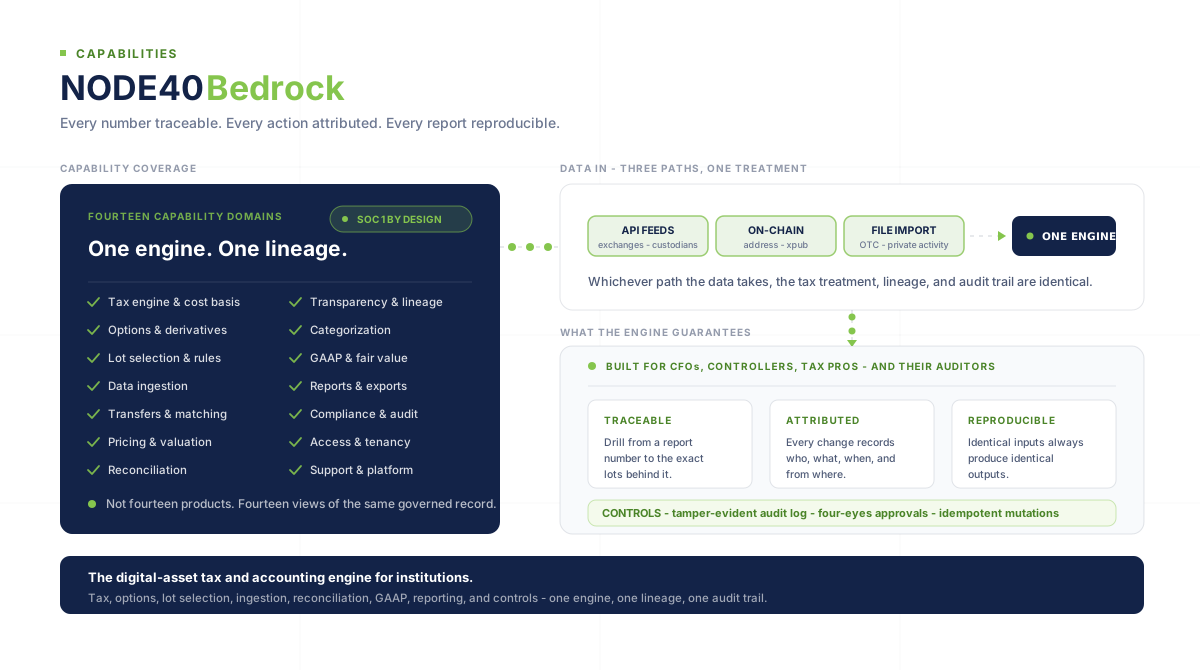
Bedrock capabilities, organized for review.

A digital-asset tax and accounting engine for institutions. Built for CFOs, controllers, tax professionals, and auditors who need every number traceable, every action attributed, and every report reproducible.

NODE40 Bedrock capabilities diagram showing capability domains flowing from data ingestion into one governed tax and accounting engine.

One governed record for digital asset tax, accounting, reconciliation, and audit support.

Bedrock connects source activity, tax lots, accounting treatments, rules, overrides, approvals, reports, and evidence into a system finance teams can inspect and defend.

Pillar 01

Tax Engine, Options, OTC, and Lot Intelligence

Bedrock keeps tax treatment tied to the lots, elections, counterparty movements, rules, and decisions that produced the result.

Tax Engine & Cost Basis

  • Full spot lot tracking: every acquisition becomes a lot with immutable identity, tracked from purchase to disposition
  • Cost basis, proceeds, and fee allocation computed under current Treasury regulations (Treas. Reg. §1.1001-7 and TD 10000)
  • Swap-fee decomposition: fees paid in the disposed token, the acquired token, or split across multiple sell legs are handled correctly
  • §1091 wash sale detection with automatic basis adjustment and disallowed-loss carry
  • §1092 straddle identification with holding-period reset and loss deferral
  • §1223 holding-period tacking across transfers: lots keep their original acquisition dates when assets move between wallets
  • Short-term vs. long-term character determined per lot, per disposition
  • Charitable donation treatment with zero-gain election
  • Retroactive lot designation: designate specific lots after the fact, with full holding-period isolation
  • Configurable taxpayer tax policy per profile

Options & Derivatives

  • §1234(b) options income treatment for written options (covered calls, puts)
  • Options position lifecycle: write, close, exercise, expire, buyback
  • Straddle detection with automated suggestions and multi-leg straddle identification
  • Physically-settled option delivery tied back to specific underlying lots
  • Options import from exchange files plus manual entry for bespoke paper and OTC contracts
  • Settlement reconciliation: confirms option settlements against on-chain movements
  • Lot encumbrance tracking: know which lots are pledged as option backing at any moment
  • Backing-lot assignment with smart-pick suggestions ranked by tax outcome

OTC & External Transfer Management

  • External Transfer Rules: designate an address as a counterparty you settle through, and sends to it are recorded as transfers, not sales
  • Captured value moves to a dedicated tracking ledger, one per asset per counterparty, carrying original cost basis and acquisition dates intact: no gain or loss at send time
  • Record the disposition when the trade actually settles, not when the value left your wallet, with gain or loss computed against that original basis and holding period
  • Automatic return capture: value the counterparty sends back unsold comes home as a transfer with basis restored, so a round trip nets to zero tax events; anything beyond the tracked position books as an ordinary deposit at market value and is flagged for review
  • Retroactive application with a full preview: see which transactions a rule captures and how gain/loss changes before you save it
  • Guardrails throughout: real evidence always beats designation, closed periods are never touched, and each rule shows exactly what happened to every transaction its addresses cover
  • Turning a rule off reverses it cleanly, and the tracking ledgers remain as the record of what it did

Lot Selection & the Rules Engine

  • Standard strategies: FIFO, LIFO, HIFO, LOFO, plus long-term-first and loss-first variants
  • Profile-scoped, priority-ordered rules that decide which strategy applies to each disposition type (sell, send, transfer, fee, option encumbrance)
  • Rules can target ledger attributes (e.g., treasury vs. exchange wallets)
  • Specific-identification (SpecID) overrides for hand-picking exact lots on any disposition
  • Lot-selection preview: see the tax result of each strategy before committing
  • Lot locks: fence off lots so automated selection never consumes them
  • Every allocation records *why* that lot was chosen (strategy, rule, override) as a permanent, auditable reason code
Pillar 02

Ingestion, Matching, Pricing, and Data Integrity

Every path into Bedrock resolves into the same lot engine, lineage model, review workflow, and audit trail.

Data Ingestion & Connectivity

Three paths in — and once data lands, the tax treatment, lineage, and audit trail are identical no matter which path it took.

  • Direct API feeds to exchanges and custodians, with new venues added on customer demand
  • On-chain wallet ingestion by address or xpub, with chain-agnostic downstream treatment
  • Structured file import for OTC, private, and other activity that no API reports
  • Identical tax treatment, lineage, and audit trail regardless of whether data arrived by feed, wallet, or file
  • Opening-balance and opening-lot import for onboarding mid-history
  • Incremental sync so new activity imports without rebuilding history
  • Controlled onboarding and source management, including through-date imports, credential diagnostics, run reports, ledger tagging, and pause, resume, rewind, delete, and restore controls
  • Nothing is silently dropped: records that fail to ingest are held for review, with a redacted row viewer, per-record acceptance, and one-click re-sync of the affected window
  • Spam and dust token suppression at ingest, with a re-scan sweep for history already imported
  • Fee-aware file import: fees denominated in any token or in fiat are priced at ingest and folded into basis and proceeds

Transfers, Matching & Data Integrity

  • Automatic transfer matching between your own wallets: internal moves are never mistaken for taxable sales
  • Confidence-tiered matching (transaction hash > address > amount) with a recorded match score and reason
  • Basis carries across matched transfers, split lot-by-lot from the source side
  • Unmatched outflows surface as review items rather than silently becoming dispositions
  • Canonical asset identity: ledgers and prices resolve by asset identity, not ticker, so same-symbol tokens from different contracts stay distinct end to end
  • Duplicate and discrepancy detection with guided resolution
  • Trade discrepancy review with side-by-side source comparison
  • Validator and staking reward attribution by validator

Pricing & Valuation

  • Source-provided prices used first: the price your exchange reported is the price Bedrock books
  • Independent market-price oracle as fallback
  • Prices resolved by asset identity, so two tokens sharing a ticker never inherit each other's marks
  • Historical price cache for consistent, reproducible valuations
  • Manual price override on fair-value computations, with audit trail
  • Trade-discrepancy price selection when sources disagree
Pillar 03

Activity Coverage and Classification

Bedrock classifies protocol activity, user decisions, tags, notes, and ledger organization in the same governed record.

DeFi & Protocol Activity

  • Lending and borrowing: loan proceeds and repayments classified distinctly, with pledged collateral tracked without double-counting it in reconciliation
  • Liquidity positions valued from the assets backing them rather than a quoted price on the receipt token
  • Bridge crossings recognized as your own transfers between chains, not as sales
  • Token migrations and contract upgrades carry cost basis and holding period across the swap
  • Protocol settlement activity classified in its own right
  • Gas and protocol fees classified and allocated under the same fee rules as everything else
  • NFT detail: token standard and item identity carried through to transaction detail

Categorization & Organization

  • Activity categorization for income, staking, mining, payments, transfers, lending, bridging, and other source-attested events
  • Three-tier category precedence: user override > rule > source-attested, so users retain final control
  • Category override and revert per transaction, with audit trail
  • Address book: named addresses with labels that appear across the timeline and filter views, with CSV import and export
  • Organization and profile-level tags, with a rules engine to auto-apply tags by criteria and re-apply on demand
  • Organization-defined custom fields and transaction notes
  • Ledger display names, favorites, and archiving
Pillar 04

Reconciliation, Transparency, and Explainability

Bedrock is designed to answer the review question behind every reported number: where did this come from?

Reconciliation & Review

  • Balance reconciliation: computed balances checked against custodian-reported balances, continuously
  • Double-entry reconciliation report: every value movement counted exactly once; portfolio difference must collapse to zero
  • Action Required: a single queue for everything needing a human decision: inventory shortfalls, over-encumbered lots, balance breaks, GAAP shortfalls, held-back records, unallocated fees, and external-transfer exceptions
  • Outstanding items surface in navigation counts and in import completion emails, so nothing waits unseen
  • Shortfall resolution workflows: acknowledge, escalate, or resolve with a synthetic deposit: each choice recorded
  • Opening-balance roll-forward reconciliation for mid-history onboarding
  • Options settlement reconciliation against underlying movements
  • Escalation path to support built into every reconciliation surface

Transparency — "Where Did This Number Come From?"

  • Inline basis math on every lot and disposition: drill from a report number to the exact lots behind it
  • Full lot lineage: parent/child links across splits and transfers, back to original acquisition
  • Per-transaction running balances
  • Transaction timeline view with export
  • Source-record retrieval: view the raw record from the exchange or chain that produced a transaction
  • Selection-reason on every allocation: the audit answer to "why this lot?"
  • Related-transaction linking (fills, fees, settlements grouped together)
  • Deterministic recalculation: identical inputs always produce identical outputs
Pillar 05

GAAP Books, Fair Value, Reports, and Exports

The same activity can support tax books, GAAP books, reporting packages, and export workflows without rebuilding the record each time.

GAAP Books & Fair Value

  • Dual-book accounting: tax books and GAAP books maintained side by side from the same activity
  • ASU 2023-08 fair-value measurement for crypto assets, computed per period
  • GAAP asset-scope classification (which holdings are in scope for fair-value treatment)
  • GAAP pools with effective-dated membership and average-cost or FIFO tracking
  • Restricted holdings: positions under lockup carried as restricted, not freely disposable
  • Event-sourced GAAP entries ready for journal-entry export
  • GAAP shortfall detection and guided resolution
  • Fair-value backing detail export

Reports & Exports

  • Report Center: self-service report builder with a growing catalog
  • Tax and activity reports, including gain/loss, unrealized gains as of any date, token activity, and crypto income reporting
  • Reconciliation balance sheet report
  • Staking analysis report: validator positions, controlled withdraw authorities, and lockup exposure
  • GAAP reports, including position, gain/loss, crypto income, and book/tax differences
  • Excel downloads with full on-screen views and automatic bundling for very large outputs
  • Filtered exports for audit trail, opening balance, timeline, transactions, lots, and audit views
Pillar 06

Controls, Access, Administration, and Platform Support

Bedrock treats controls, tenancy, help, and operations as part of the product surface, not as afterthoughts.

Compliance, Audit & Controls (SOC 1)

  • Designed for SOC 1 Type 2 from day one: controls, not promises
  • Complete audit trail: every change records who, what, when, from where
  • Tamper-evident audit log: database-level protection; records can never be edited or deleted, even by administrators
  • Authorization denials are themselves audited events
  • Four-eyes (maker-checker) approvals on sensitive operations: no one can approve their own proposal
  • Per-organization compliance matrix: you decide which operations need approval, and how many approvers
  • Period close and reopen with recorded snapshots
  • Idempotent mutations: retries and double-clicks can never double-post
  • Evidence-grade data model: lots, proposals, and approvals are never destructively deleted
  • Reproducible calculations: decimal-exact math, no floating point, pinned regression scenarios

Access, Tenancy & Administration

  • Enterprise single sign-on with short-lived signed tokens
  • Role-based access control over every operation in the product
  • Fine-grained permission resolution drives the UI so users only see actions they are allowed to take
  • Strict profile-level tenancy isolation, enforced at the data layer and verified at build time
  • Organization administration and onboarding, including user invites, role grants and revocations, session revocation, profile switching, sandbox profiles, and per-feature elections
  • Feature toggles that respect data safety, so a feature holding live data cannot be switched off silently

Help, Support & Platform

  • Bedrock Course: built-in guided learning track for the product and its tax concepts
  • Inline contextual help on complex concepts with deeper documentation links
  • In-product support escalation routed to a staff queue with full context attached
  • Notifications, live status updates, and scheduled background processing for imports and recalculations
  • Fully documented REST API through OpenAPI and Swagger: everything the UI does, customer systems can do through the API
  • Calculation work is serialized per profile, so concurrent edits and imports can never interleave into an inconsistent result
  • Architected for institutional volume: history grows, recalculation stays incremental, and reads stay paged